

Curriculum
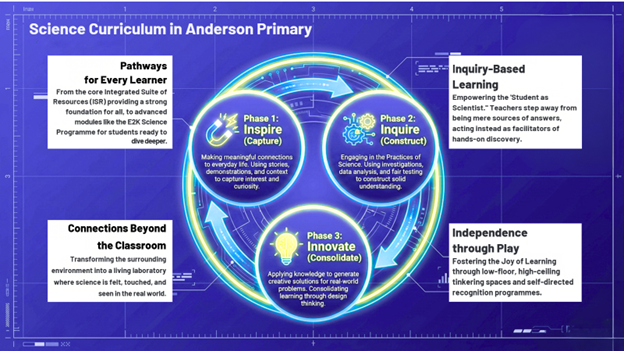
Our Pedagogical Approach: The 3Cs
In alignment with the national Science Curriculum Framework, our teaching is centered on the "3Cs" to ensure students learn with deep understanding:
-
Capture: We use engaging tools like role-playing, concept cartoons, and annotations to spark students' interest and capture their initial ideas.
-
Construct: Students build their understanding through hands-on investigations and the use of the Integrated Suite of Resources, such as the SPARKLE Kits and SLS resources.
-
Consolidate: Learning is reinforced through reflection and the application of concepts to real-world contexts.
We believe in Inquiry-Based Learning, where students are "Inquirers" and teachers act as "Facilitators". This approach encourages independence and fosters a lifelong joy of learning.
Our Educational Framework for Science Education
1. Tailored Pathways for Every Learner
We recognize that every child has a unique starting point and different interests. Our curriculum is differentiated to ensure that all students are both supported and challenged:
-
For All Students: We provide a strong foundation through the Integrated Suite of Resources (Textbook, Activity Books, and SLS), ensuring core concepts are accessible and clear.
-
Advanced Learning Opportunities: For students ready to dive deeper, we infuse advanced modules like the E2K Science Programme, which focuses on high-level scientific investigation and critical thinking.
2. Inquiry-Based Learning: The Student as Scientist
At the heart of our pedagogy is Inquiry-Based Learning. We shift the role of the teacher from a "source of answers" to a "facilitator of discovery."
-
The 3Cs Framework (Capture, Construct, Consolidate): Lessons often begin by capturing interest through concept cartoons or role-playing. Students then construct their own understanding through hands-on experiments using SPARKLE Kits and STEM Boxes.
-
Developing "The Practices of Science": Instead of just reading about facts, students learn how to ask "Why?", design fair tests, and use evidence to support their claims. This fosters a sense of independence and intellectual curiosity that lasts a lifetime.
3. Connections Beyond the Classroom
We believe Science is best learned when it is felt and seen in the real world. Our "Outdoor Learning" modules transform the school environment into a living laboratory:
-
"Every Child a Seed" & Urban Farming: Students don’t just draw plants; they nurture them. From transplanting seedlings to harvesting vegetables, they witness the cycle of life firsthand.
-
Learning Journeys: Whether it is a trip to the Zoo to study animal traits or exploring sustainability through solar and wind energy modules, we ensure that what is learned in the textbook has a direct link to the world outside.
4. Encouraging Independence through Play
Learning Science at Anderson is also about the "Joy of Learning."
-
The Young Scientist Badge Scheme: This self-directed program encourages students to take initiative. Students complete tasks independently, earning badges that celebrate their curiosity.
-
STEM Playgrounds: These provide "low-floor, high-ceiling" activities where students can tinker and experiment freely, building resilience when their prototypes fail and innovation when they finally succeed.
By blending rigorous inquiry with real-world application and personalized support, we ensure that every Science lesson is an opportunity for students to wonder, explore, and grow.